Changing expectations to realise the benefits of AI in meetings
Imagine being in a council where one has a morning session which sets the agenda, followed by an automated synthesis and a brief individual review powered by AI chatbots that allow participants to understand the topic, what has been discussed and can develop their thinking further. Then, instead of adjourning for a week, the team reconvenes two hours later for a twenty-minute meeting. For those who like to have time to reflect before forming or sharing opinions, one could even allow the AI to help develop their arguments and contribute them to the meeting.
This second meeting becomes a decisive action point rather than a status update, keeping the cognitive load fresh and momentum high. Compressing the feedback loop, managers can drive significantly higher engagement and output.
This cadence and style of meetings is not normal in councils, as while AI can generate outputs such as automated meeting notes with unprecedented speed, many are struggling to capture the corresponding efficiency gains. This deficit does not stem from a defect within the AI, but because efficiency gains require a change in expectations from management that requires conscious and deliberate change.
Take the above meeting cadence proposed above for instance. In many parts of local government, teams have administrative workflows that have been structured around timelines from another era. In the flow diagram below I set out how meeting notes used to be processed.
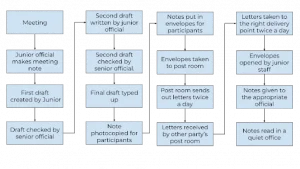
I’ve not included the sub steps of time that had to be factored in for it getting to the top of someone’s in-tray and then the time needed to read, digest and discuss with peers or superior officers. Not to mention the time to lay out several important documents or meeting notes in a quiet room where its implications are fully considered. Notes would take weeks to follow a meeting and then be received by the participants. Another meeting would often follow and a few weeks’ notice would be required to bring everyone together again.
These heritage processes have bled through into expectations of waiting days, or even weeks, for documents, plans and notes from meetings that continue to this day. But the difference before was the actual period of deliberations and thought built into the process and an expectation of active engagement in meetings.
Now meeting notes take seconds to produce with AI can be checked within the hour, but this time, it is rare for attendees to read and think about the notes.
AI and modern technologies have shifted the underlying paradigm of information scarcity and a slow means of processing that information to one of an abundance of information. We live in a new paradigm where the immediacy, communication, access, and processing of data happen at speed and quantities that could not have been imagined even ten years ago. Yet somehow people seem to have less time than ever before and meeting notes are rarely read because of lack of time or a peaceful place in the office to concentrate. Our processes and technology have fallen out of alignment with little increase to the speed of delivery nor with workloads decreasing.
We have yet to accept that new technologies in the workplace have created extra capacity and paradoxically inefficiency increases when organisations fail to reallocate this reclaimed capacity. Meetings explode in number, but outputs shrink.
If meetings are still scheduled on weekly cadences without teams leaning into the use of near real-time briefings momentum is potentially lost.
Without acknowledging these shifts in data and communications, teams can get overwhelmed with potential information and default to status updates, where the discussion revolves around synthesising materials rather than executing strategy. The time saved by automated processes is effectively absorbed by existing administrative inertia, neutralising the efficiency gains.
Managers treat the newly acquired time not as an opportunity to accelerate decision-making, but as a buffer, relying on the delay as a proxy for thoroughness and attempts to change this run the risk of hitting this psychological barrier. Managers often perceive the gap between meeting and output as a period of necessary deliberation. This perception can function as a safeguard for professional identity, where the time span itself becomes a proxy for competence, creating the illusion of productivity even when the cognitive deliverables remain unfulfilled. To counter this organisations must pivot from monitoring processes to evaluating impact. The metric of success of administrations like councils must transition from the activity they do around a problem such as ‘holding consultations’ to the tangible reduction of community demand and the substantive elevation of resident well-being. Existing decision gates must be evaluated to ensure they continue to add value in the new processes. Where they don’t, they need to be removed or stripped back.
If we can accept that we attend meetings where it is clear that no-one reads the notes, then waiting days for minutes and weeks for a new meeting serves no purpose. A hyper-responsive cadence is possible with current technology fruitfully deployed. Working with modern technology and its inherent cadence would allow teams to benefit from the faster pace caused by AI and allows humans to do real, deep thinking and reach new decisions quickly.
This operational transformation is fundamentally an exercise in change management in office protocol. It requires reframing technology not as a device for tactical speed, but as the foundational architecture for an abundance model of information and information processing. By guiding council leads through this transition, organisations can ensure that their investments in automation fulfil their purpose: establishing a resilient, responsive, and structurally sound community that moves at pace with a verifiable efficiency that is felt in transformed internal processes as well as on the balance sheet.