Why is GovTechTokyo focusing on Digital Public Goods?
GovTechTokyo was established in 2023 as an organization working with the Tokyo Metropolitan Government (TMG) to accelerate digital transformation (DX) within the TMG and 62 municipalities in Tokyo.
Our objective is to combine the strengths of both public and private sectors, serving as a hub that connects diverse stakeholders and brings cutting-edge insights that lead to new service creation into GovTechTokyo. While the methods and case studies of public-private co-creation that have emerged through these initiatives are a very broad theme, in this blog I will focus on Digital Public Goods.
Digital Public Goods: Jointly created and used by many
“Digital Public Goods” (DPGs) are defined as open-source software, open data, open AI models, open standards and open content that adhere to privacy and other applicable laws and best practices, do no harm and help attain the Sustainable Development Goals (Source: Digital Public Goods Alliance).
The UN Secretary-General called on member states in 2020 to cooperate in developing DPGs, and in 2022, the Digital Impact Alliance and the Digital Public Goods Alliance jointly announced The Charter for Digital Public Goods. More recently, many sessions at the international event “Funding the Commons Tokyo 2024” were dedicated to DPGs, attracting significant attention.
At GovTech Tokyo, “Digital Public Goods” are defined not simply as convenient applications, but as software, data, and knowledge resources (such as guidelines) that can be reused across municipalities and are published and governed so that improvements can accumulate over time. In our mid-term management plan and its appendices, we set KGIs (Key Goal Indicators) to create Digital Public Goods across multiple fields as software and data governed by appropriate rules, and we outline concrete measures to transition them into public goods, including establishing publication and operational policies, supporting open-data initiatives, open-sourcing internally developed services, and publishing guidelines.
From a stakeholder perspective, GovTech Tokyo works with the TMG’s Bureau of Digital Services to accelerate DX across the metropolitan government and its 62 municipalities, and we therefore see the primary “joint creators” as a federation of metropolitan and local governments. At the same time, we do not limit Digital Public Goods to public institutions; through public-private co-creation with startups, civic-tech communities, and hackathons, we aim to elevate promising solutions into reusable public assets. In other words, GovTech Tokyo’s approach is not to “publish and finish,” but to prepare support mechanisms in advance so that solutions can circulate and improve as public goods.
The four categories of DPGs
According to Mr. Miyasaka, the President of GovTechTokyo, DPGs can be broadly divided into four categories (see the diagram below).
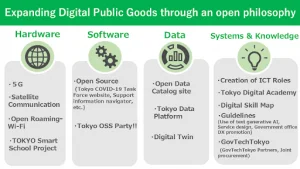
For example, in the “Software” category, the goal is to enhance both the quantity and quality of open-source resources. Open source means that the software’s source code is publicly available, allowing anyone to freely use, modify and distribute it. This openness enables developers and researchers to collaborate, accelerate improvement and updates, and provide highly reliable information. In times of emergency like during a pandemic, speed and transparency become especially crucial.
A concrete software example is our Benefits Navigator (also called the Support Information Navigator): a resident-facing tool that helps people—especially families with children, pregnant people, and others facing life challenges—quickly find which public support programs they may qualify for and run simple “what-if” simulations. It works by registering administrative rules and encoding them in OpenFisca so eligibility and benefit amounts can be calculated transparently and consistently.
It can be considered a DPG because it is designed as an open-source, reusable public infrastructure component that improves access to services, strengthens transparency of policy logic, and can be adopted and adapted across jurisdictions with privacy- and safety-by-design. It has been used so far through a PoC (Proof of Concept) with public-sector stakeholders to validate rule coverage and user flows, and to support iterative improvement toward broader deployment.
In the “Data” category, for example, the TMG published the registry of childcare services which consolidates all public information about childcare support systems such as financial support and consultation services in each municipality across Tokyo and in the TMG, so that anyone can easily find and use this information. This registry also supports push-based notification in collaboration with private businesses, enabling proactive delivery of necessary information to Tokyo residents.
Systems and knowledge as DPGs
An important category to highlight is the “Systems and Knowledge”. In Tokyo, various guidelines such as those on the use of generative AI or service design are published not only for internal use within the TMG but also with the assumption that they will be referenced and adapted by prefectural and municipal governments nationwide.
Through initiatives like “GovTechTokyo Partners” and “Joint Procurement”, we aim to optimize resources ―both in terms of talent and funding― while also prioritizing the sharing of know-how and expertise.These efforts form a core part of the “Systems and Knowledge” category of DPGs.
Next steps
In GovTechTokyo, we believe that DPGs cannot be created by our members alone. They must be co-created through collaboration with diverse stakeholders such as TMG or municipal employees, private sector partners and experts from various academic fields.It is also essential to continuously refine the DPGs together with Tokyo residents through their participation.
These efforts can be strongly promoted within GovTechTokyo, where talent from the public sector and the private sector work closely together. We will continue to advance initiatives that place a strong emphasis on Digital Public Goods.
This blog was written by Ikuo Koboku, Manager of the Co-creation in Public Services Division at GovTechTokyo.