

Residents are already using Generative AI to make applications for council services, such as Freedom of Information (FOI) requests, Subject Access Requests (SARs), Penalty Charge Notice (PCN) challenges, and complex Council Tax inquiries. This is causing an increase in the frequency and complexity of multi-stage submissions, risking boroughs getting overwhelmed by demand, a phenomenon sometimes referred to as “Agentic Flooding”. Individual councils lack the time, effort, and resources to build their own Agentic AI solutions to solve these application backlogs.
LOTI is therefore facilitating a collaborative project to help boroughs use Agentic AI to connect their own services and interact with residents directly. This will mean the resident gets a quicker resolution to their problems, and councils can answer the overwhelming amount of Gen AI-powered applications.
Purpose
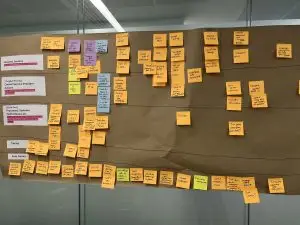
This project aims to create common service patterns for how to evolve council services to use Agentic AI. LOTI will work with 3-5 member councils to map their ‘As-Is’ processes—looking at People, Tech, Data, and Process—and then work with them to co-design a ‘To-Be’ pattern. The team will explore what barriers might prevent boroughs from adopting these models, revealing gaps or technical requirements, such as legacy integration issues.
Based on suggestions by the boroughs, the discovery focuses on three high-demand areas:
- Freedom of Information (FOI) & Subject Access Requests (SARs): A multi-service challenge experiencing significant demand spikes.
- Adult Social Care (Front Door): Specifically focusing on complex assessment paradigms like safeguarding referrals or home care amendments.
- Council Tax: A more simplistic, transactional paradigm that requires identity validation.
Project approach
The workstream kicked off its first sprint on 17 April 2026, bringing together several London boroughs to align on the scope and outcomes of the project. Moving forward, the project is structured as a 5-sprint programme that will run for approximately 6-8 weeks.
Ultimately, the finalised service patterns, technical roadmap, and lessons learned will be written up and shared with all LOTI members, providing a clear roadmap for other councils to implement the systems themselves if they wish to do so.
Latest update
Following on from our in-person service mapping workshops, LOTI has partnered with techUK and Barking and Dagenham Council to map out delivery options for councils looking to deploy Agentic AI. Together, we looked at what tools already exist on the supplier market via a techUK member survey, and explored how boroughs could design, sequence, and build their own Agentic AI solutions in-house.
Our findings indicate that rather than creating separate bespoke tools for every use-case, the most effective approach would be to build a common, reusable AI-assisted pre-case handling layer.
This layer would act as an intelligent ‘front door’ handling guided intake, clarifying missing evidence, summarising submissions, and flagging risks before preparing a structured handoff pack for existing back-office case management systems.
We have created indicative delivery timelines (based on assumptions around team size) for each of the application areas: The Reusable Pre-Case Handling Layer, Freedom of Information (FOI) Requests, Subject Access Requests (SARs), Council Tax Enquiries & Move/Discount Handling, Care Act Assessments, Safeguarding Referrals. More details have been provided directly to LOTI members.
Next Steps
LOTI will focus on advocacy and knowledge sharing of agentic AI as participants emphasised that successfully deploying Agentic AI requires strong senior leadership buy-in and depends just as much on culture, process, and engagement as it does on technology.
LOTI will continue to share knowledge and integration strategies from boroughs.
For more information please email contact@loti.london.