Public Service Reform: from cashable savings to radical change
In my opinion, there are two main ‘buckets’ of public sector innovation.
Bucket 1 is about optimising our current services – largely with the aim of balancing this year’s budget.
Bucket 2 is about designing completely new interventions so that we can have effective and financially viable services for the future.
Clearly, the world needs both. But in this blog, I want to make the case that we urgently need much more ‘Bucket 2’, radical change thinking.
Right now, it seems like most public sector organisations are judging innovation initiatives by the immediate cashable savings criterion of Bucket 1, making it almost impossible to work on the more radical Bucket 2.
I believe that’s a mistake, as I’ll now explain.
Why we can’t just improve what we have
In a previous blog, I argued that you could summarise the challenges facing the UK public sector in a single statement: “We have more demand than we can ever meet with our current budget and service model”.
Today, it’s well known that demand is vastly outstripping the capacity of some services to respond. Budgets are getting tighter. London borough councils alone face a £4bn funding shortfall.
As they seek to respond, public sector professionals often tell me they feel like they’re stuck on an endless treadmill of finding ways to make yet more cuts or optimisations to balance this year’s budget (Bucket 1). They deserve enormous credit for surviving that way for so long. But it doesn’t address the underlying demand pressures.
It reminds me of the famous Henry Ford quote: “If I’d asked people what they wanted, they would have said faster horses.” Might it be that what we’re mainly doing in the public sector is strapping on roller skates and rocket boosters to horses, when perhaps the conditions we operate in have so fundamentally changed that we need to explore a car-shaped paradigm shift?
Put bluntly, in some service areas, no amount of tweaking or improving what we currently do will ever be enough. We simply have to think differently.
So let’s dive into examples of Bucket 1 and Bucket 2. I’ll explain what I think is fundamentally different about them. We’ll then finish by asking what it would take to put more radical change thinking into practice.
Examples of Bucket 1 and Bucket 2
Let’s look at three examples that relate to the world of health and care.
The first is a Bucket 1 example. Many councils get hundreds of emails to their Adult Social Care inbox every day. Some are basic notifications. Others are desperate calls for help from local residents. Councils can use AI to triage that inbox to identify the most urgent cases for attention. Does it improve efficiency? Yes. Does it do anything to stem the tide of demand or increase care capacity? No. Should we do it anyway? Of course.
Our second example falls into Bucket 2. A Dutch nursing home has established a programme providing free rent to university students in exchange for 30 hours a month of their time “acting as neighbours” with their care home residents. I love how this takes two problems – students struggling to afford rent, and care homes without enough care capacity – and puts them together to create each other’s solution.
The third example is also Bucket 2. The GoodSam app enables ambulance trusts to send out an alert via an app to qualified first aiders in the vicinity of someone experiencing cardiac arrest, highlighting their location and that of the nearest defibrillator so they can provide vital support before the ambulance arrives. These off-duty nurses, paramedics, doctors, police, fire and first aiders save many lives each year, tripling the chances of survival.
While all three examples are useful, notice how only the Bucket 2 examples actually increase capacity to respond to a social issue.
How do you create radical change solutions?
Some radical change initiatives come from completely outside of, and require nothing from, the public sector. Many charities would argue they operate in this space.
However – as someone working on public sector innovation – I want to look at this through the lens of how our sector can make a proactive strategy of nurturing radical change interventions. So how do you do that?
Let me share what I think’s going on under the hood. One way of thinking about this links to LOTI’s Service Innovation Cards. These cards (see below) highlight 36 different factors or variables you can change to improve a service.
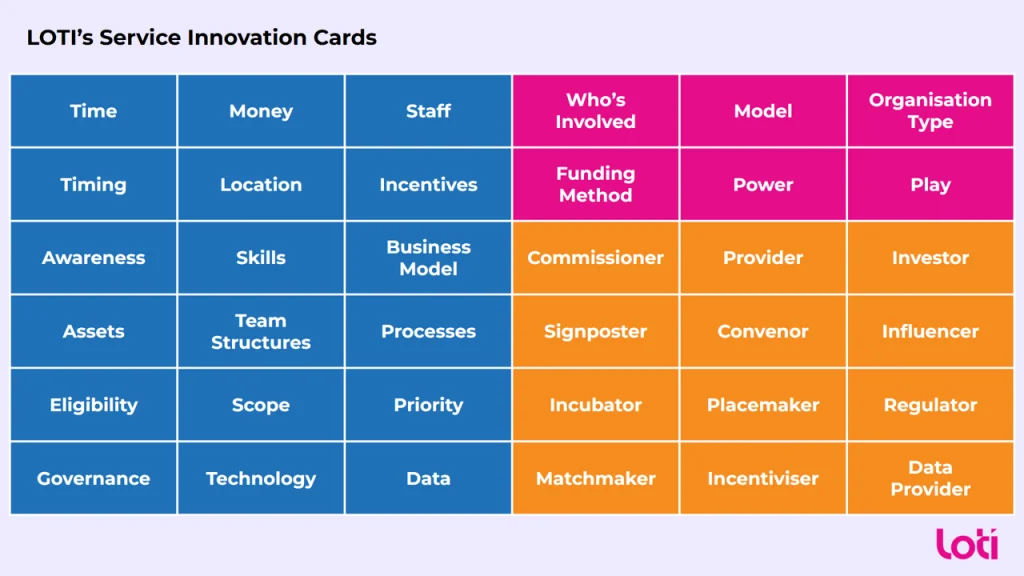
The ones in blue are those that public sector organisations tend to use all the time. If all you do is use those blue variables, you’re likely to optimise your current service model (Bucket 1). But if you’re willing to expand your toolkit by adding some of the extra factors in pink, and consider playing a different role as the public sector in yellow, far more radical alternatives emerge (Bucket 2).
The AI triage tool outlined above changes just one (blue) factor: technology. Yet in the case of the Dutch care home example it changes who can be involved (pink), it changes the role of the public sector to Matchmaker (yellow: connecting students with care homes) and Incentiviser (yellow: encouraging students to become part of local care capacity). In the case of GoodSam, it also changes who can be involved (volunteers) and achieves the role of Matchmaker by being a Data Provider: revealing data on the location of the patient and the nearest defibrillators so that others can act.
What holds back radical change?
There are significant barriers to embracing that wider toolkit.
The first is that Bucket 2 solutions are unlikely to map perfectly onto current service models or organisational boundaries. As a result, they can fall between the gaps in our commissioning models. For a case study, look no further than the Tribe Project, a multi-award winning, highly-evidenced approach to boosting local care capacity, tackling bed-blocking and boosting local economic growth, with impressive Return on Investment figures. Yet because it cuts across both local government and NHS remits, it seems neither is easily able to step forward to commission it sustainably.
Second, some public sector professionals point out that regulations make this sort of innovation challenging, for example where the law requires the public sector to solve a problem in a specific way, or to guarantee a particular outcome. (What do they do if a volunteer doesn’t turn up?)
Thirdly, radical change solutions, by their nature, are more experimental. The process of developing them cannot guarantee cashable savings this year or even next. It’s implausible to ask public sector organisations to each be coming up with paradigm-shifting new service models. They simply don’t have the time, money, resources or risk tolerance given the scale of their budget challenges.
So what do we do?
To my mind, unless we want to accept that life in the public sector will forever be framed around painful conversations on what we cut next, we simply have to find a way to focus more attention on radical change.
Somebody, somewhere needs to have the full-time job of developing the effective, ethical and financially sustainable public service models of the future.
Imagine if the UK had centres that were dedicated to designing the next generation of public services. Places that had the space, time and expertise to distil some of the nation’s greatest public sector problems to their most fundamental level and then bring massive creativity to design radical new solutions focused on a deep understanding of user needs.
Places that could harness the best minds from the public, third and private sectors – as well as residents themselves – to generate new service models that are effective and financially viable over the longer term, and may look nothing like the way things are done now.
Places that can inspire city mayors and public sector leaders with a whole new menu concerning the art of possible, giving them a north star to aim towards in their reform efforts.
Regional innovation bodies like LOTI are a natural home for this. Working across multiple parts of local government, the wider public sector and VCSs (Voluntary and Community Sector), we already have the organisational relationships and the knowledge of what it takes to deliver radical change on the ground. Our model is already about pooling resources to share the time, cost and risk burden of trying new things. Different regions could each take a major problem and develop radical change interventions that could be shared to benefit the whole nation.
Yet this sort of innovation requires investment to do properly. And we need help from national government to figure out what needs to change about the commissioning landscape to ensure these more radical models can be scaled.
So let me finish where I started: There are things public sector organisations have to do to balance this year’s budget. There’s a very different set of things they need to start right now to ensure they have effective, financially viable services 3 years+ from now.
Both are needed.
But if I could urge one mantra for public sector leaders, it would be:
“Be more Bucket 2!“

Eddie Copeland