

LOTI is working with Warmer Homes London to scale the use of Internet of Things (IoT) sensors across the city. Building on LOTI’s Damp and Mould Sensor Pilot, this project aims to scale the use of sensors across London’s social housing sector. It aims to better understand retrofit performance, manage damp and mould risk, and comply with new legislation.
Introducing Warmer Homes London
Warmer Homes London (WHL) is a joint venture between London Councils and the Greater London Authority (GLA). WHL will oversee retrofit delivery across the city to make Londoners’ homes greener, healthier and more affordable to heat.
WHL oversees two government funded programmes including the £78 million Warm Homes: Social Housing Fund.
Warm Homes: Social Housing Fund is led by a Strategic Partnership which includes 21 London Boroughs and 6 Housing Associations, targeting the completion of retrofit measures on 8,224 homes by 2028.
Key Objectives
Warmer Homes London is developing a Data and Digital Strategy. This will leverage London’s data and digital innovation skills to improve decision-making based on energy performance insights.
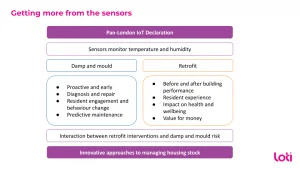
A key of this strategy is working with Warm Homes: Social Housing Fund partners to adopt IoT sensors as part of their retrofit programmes. Temperature and humidity data from these sensors will be combined with energy consumption data and retrofit intervention costs to provide the following insights:
- Understand the before and after performance of retrofit interventions with regards to damp risk, both locally and across London
- Understand the overall performance of retrofit interventions including cost / benefits to residents
- Uncover insights that lead to the development of new, enhanced asset archetypes that factor in building performance
- Identify if / where retrofit activities are leading to increased damp and mould and identify remediation activities
These insights contribute to WHL’s wider goals of increasing the pace and scale of retrofit across London and improving homes for London residents.
Lessons from LOTI’s Damp and Mould Sensor Project
This project directly scales the learnings from the LOTI Damp and Mould Sensor Pilot. The pilot confirmed early use cases:
- Proactive and early identification of damp and mould risks.
- Identifying root causes and assessing the effectiveness of interventions.
- Resident engagement and behaviour change.
- Predictive maintenance through forecasting repair needs.
Despite strong interest (boroughs committed to deploying an additional 3,500 sensors post-pilot), scaling challenges are evident. This includes: limited internal capacity, resident mistrust, and difficulty building a business case without stronger impact data.
This project aims to resolve these by facilitating knowledge sharing across the partnership; creating bespoke resources; aligning partners’ internal teams; and leveraging the grant funding to scale adoption and drive strategic London-wide insights.
Preparing for Awaab’s Law
The project also supports social landlords in preparing for Awaab’s Law. From October 2025, this law introduces legally binding deadlines for social housing landlords to address serious health hazards reported by tenants.
Temperature and humidity sensors can help social landlords prepare for Awaab’s Law by enabling a proactive, data-driven approach to identifying and fixing problems before they become serious hazards.
While government guidance confirms that risk notifications from monitoring systems do not in themselves trigger the legal timeframes, IoT sensors can support social landlords with:
- Early Hazard Detection: Flagging risks before they become legal hazards.
- Preventative Maintenance: Guiding maintenance to prevent serious issues.
Evidence and Accountability: Providing data on housing conditions and - intervention effectiveness.
- Resident Engagement: Supporting conversations about property conditions and ventilation.
The data opportunity
There is an opportunity to align the use of sensors with Warm Homes: Social Housing Fund to adopt innovative approaches to managing housing stock.
There is already a strong alignment between the 12 boroughs who took part in the Damp and Mould pilot and those in the Strategic Partnership.
Over 8,000 properties will be undergoing retrofit works in the next three years. There is an opportunity to utilise this programme to accelerate the adoption of sensors, supporting partners to comply with Awaab’s Law, better understand damp and mould risk and measure retrofit outcomes at a London level.